

The biggest mistake people make when trying to learn Generative AI is assuming the journey starts with tools.
It does not.
Tools change constantly. The foundations do not.
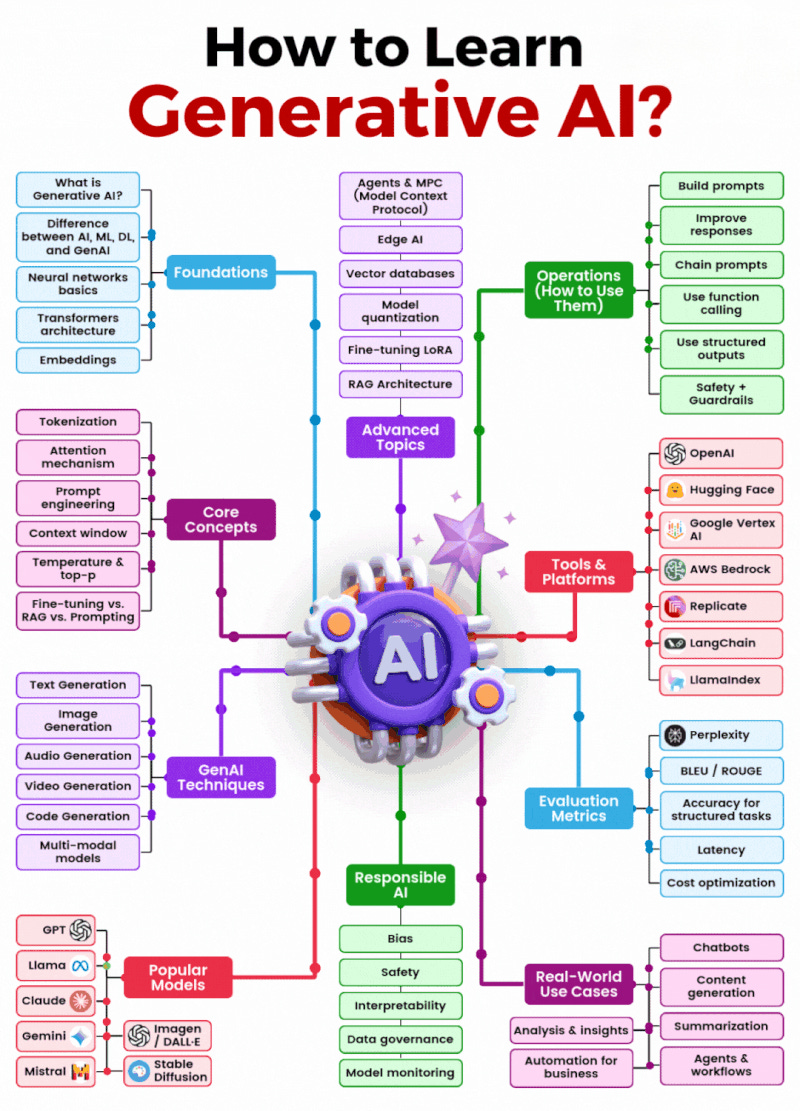
If you look closely at the landscape of Generative AI, the learning path becomes much clearer. It starts with understanding the fundamentals that power the technology. Concepts such as neural networks, transformers, embeddings, and the difference between AI, machine learning, deep learning, and generative models form the intellectual infrastructure behind everything we see today.
From there, the next layer is mastering the core mechanics of how these systems behave. This includes prompt engineering, context windows, tokenization, temperature settings, and the strategic difference between prompting, fine tuning, and retrieval augmented generation. These elements determine how effectively you can actually work with AI systems.
Once those principles are clear, the focus shifts to applied techniques. Generative AI is no longer limited to text. It now includes image generation, audio synthesis, video creation, code generation, and multimodal models that combine several capabilities in a single system.
After that, the real leverage comes from understanding how to operate these systems in practice. Building better prompts, chaining prompts into workflows, structuring outputs, and using function calling or agents turns AI from a simple assistant into a true operational tool.
At a more advanced level, professionals begin working with architectures such as RAG pipelines, vector databases, model quantization, and edge AI. These are the building blocks behind scalable AI products and enterprise grade systems.
Of course, none of this works without platforms and infrastructure. Today’s ecosystem includes providers such as OpenAI, Google Vertex AI, AWS Bedrock, and open model communities like Hugging Face, along with orchestration frameworks like LangChain and LlamaIndex.
But one element sits quietly at the center of all of this.
Responsible AI.
Bias, safety, interpretability, data governance, and model monitoring are not optional topics. They are essential if AI is going to be deployed at scale in organizations.
Finally, the ultimate goal is not technology. It is impact.
Generative AI is already transforming real world work across chatbots, content creation, summarization, data analysis, automation, and intelligent agent workflows.
The professionals who will thrive in this new landscape are not the ones chasing every new tool. They are the ones who understand the structure behind the technology.
Once you understand the map, navigating the territory becomes much easier.
VisivAI Team